
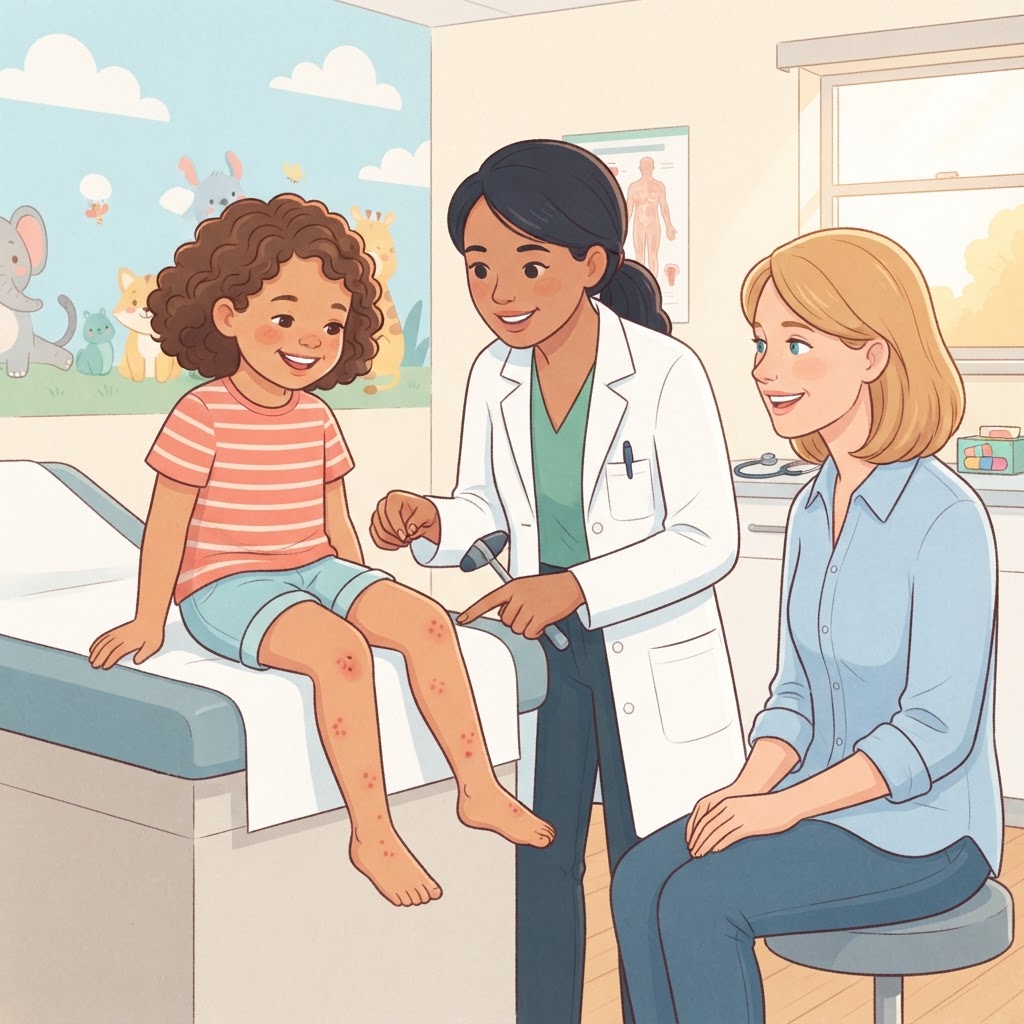
Concerned that she could have chickenpox, the preschool called mom at 10:30 in the morning to pick up her daughter. They came to the office that afternoon to be checked. She was a 3 ½-year-old who had no fever. She was happy and playful and seemed not sick at all.
There was a rash on her legs and arms. The lesions were the size of a typical pimple. They were raised and firm with some slight swelling around the outer border. More were on the legs, clustered near the ankles, about five or six on each leg, and a few on her outer upper arm. They appeared not to itch and certainly did not bother her. The striking feature was that they all were identical in appearance.
Not Chickenpox
I told mom that these were NOT chickenpox. However, they represented a hypersensitivity reaction to an insect envenomation. When one gets bitten or stung by an insect, their body may elicit a local reaction to the venom, much like her daughter had. This is not an allergic reaction and is not in any way dangerous. I would expect these to go away on their own in a few days. She is not contagious and may return to preschool. I wrote a note to that effect. Mom said that a couple of days ago they were at the park playing in a sandy area, and that night she, too, had some bites on her ankles.
What Is Chickenpox?
Chickenpox, or varicella, is a highly contagious virus that is spread from human to human through nasal droplets (coughing or sneezing). Or it can be spread by direct contact with the fluid from the blisters. When infected, symptoms usually appear 10-21 days after exposure. These symptoms include fever, decreased appetite, headache and fatigue. One-to-two days later the rash will appear. It starts on the face, chest and back and eventually spreads all over the body. The rash can occur inside the mouth, on the eye and even in the genital areas.
The Three Stages of the Rash
The rash has three stages:
- It starts as a raised red bump (papule).
- It then gets a bit larger and has clear fluid inside like a blister (vesicle).
- The blister breaks and leaks the fluid, ultimately scabbing and crusting.
The Hallmark of Chickenpox
The hallmark of chickenpox is when looking at the skin of a patient with the virus, one will see the rash at all different stages at a given time. For instance, on the back there will be papules, some vesicles and some that have already started to crust. The rash comes in "waves" or crops. In the old literature, the classic vesicle of chickenpox is described as a "dew drop on a rose petal." It got its name because the vesicle resembled the chickpea or garbanzo bean.
Course and Treatment
A typical course of chickenpox lasts 10-12 days. One is contagious for one-to-two days before the rash starts and until every lesion has scabbed and crusted over. The treatment is typically symptomatic. In other words, one should trim the nails of a child with chickenpox as the rash can be very itchy. This will prevent any secondary infection from scratching. It is important to ensure good fluid intake since the appetite may be less than ideal. Fever control can be achieved with Tylenol or Ibuprofen. However, aspirin is absolutely contraindicated. It can cause Reye's Syndrome if used for chickenpox or influenza. Some parents will use Calamine lotion for the itchy rash, but an oral preparation such as Zyrtec is most effective.
Potential Complications
While the mortality rate from chickenpox is very low, it is not without potential serious complications. These may include pneumonia, encephalitis (inflammation of the brain), cerebellar ataxia (inflammation of the cerebellum of the brain) and sepsis (overwhelming bacterial infection). Chickenpox can be devastating to a non-protected pregnant woman, or to a person who is immunocompromised (HIV patient or a post-transplant patient on immunosuppressive drugs). It tends to be a much more serious infection in adults.
The Chickenpox Vaccine
Since 1995 a chickenpox vaccine called Varivax has been very effective. The first dose is usually given at one year of age, and then again at four or five years of age. The first vaccine gives around a 90% protection rate. The second vaccine given before school is not a booster. It is to pick up the 10% who did not get full protection with the first vaccine.
The Common Parental Argument
Some parents argue that, "Well, I remember having chickenpox when I was a child and it was no big deal…almost like a right-of-passage! I'm not gonna give my child this vaccine." The rebuttal to this argument is that the vaccine is safe and has been used in millions of cases since 1995. If a child gets chickenpox one can plan on missing at least 12 days of school. Since most school-age children are vaccinated, an un-immunized child is not likely to get chickenpox when they are young. They may not get it until they are an adult, where it can be a much more serious infection.